
Zerg rush started as a strategy term inside a video game, but it turned into one of the most talked-about search tricks Google ever built. Typing this phrase into the search bar once triggered a small game where letters attacked the screen, and players had to fight back by clicking fast. That mix of gaming nostalgia and search engine surprise made it stick in people’s minds for over a decade.
This article looks at where zerg rush actually came from, how the Google version worked, and why the term still shows up in gaming conversations today. Along the way, you will find the mechanics behind the game, common mistakes players make, and simple tips that help boost a score. Real examples and comparisons are included so the concept feels practical rather than just historical trivia.
What Does Zerg Rush Actually Mean?
Zerg rush started as a strategy term in the video game StarCraft. Players who controlled the Zerg race could produce cheap, weak units very quickly. Instead of building a strong base and waiting, a zerg rush sends a large wave of these units at the enemy right at the start of the match. The idea is simple: overwhelm the opponent before they get organized.
This tactic worked because early units in Zerg are fast to produce and cost very little. A player who rushes early can catch an opponent off guard, especially one who spends the opening minutes building defenses instead of preparing for an attack. Over time, the phrase moved beyond StarCraft and became a general gaming term. People now use “zerg rush” to describe any situation where numbers beat strategy, even outside video games.
The Google Zerg Rush Easter Egg
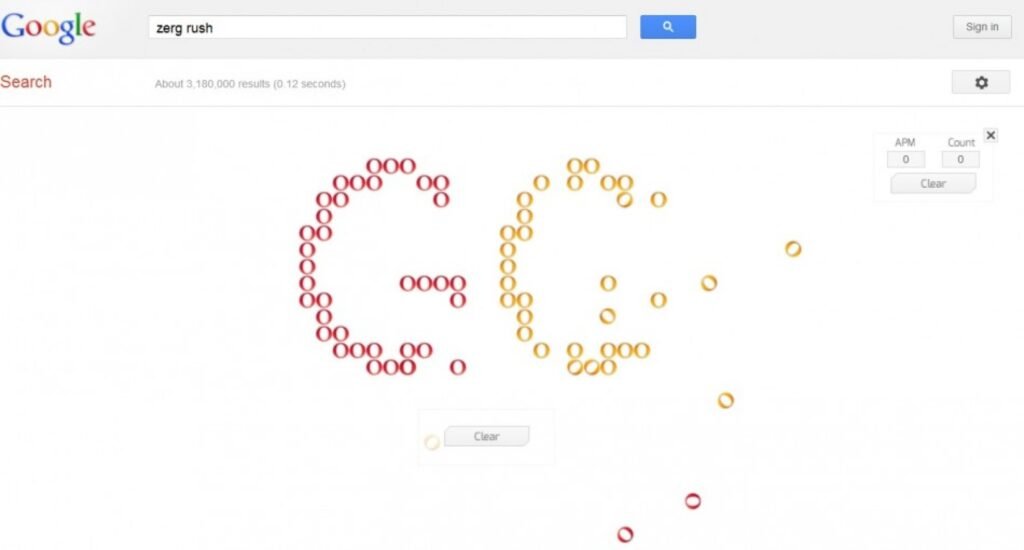
Google added an interactive twist to this gaming term back in 2012. Searching the exact phrase triggered a short animation where small letter shapes dropped onto the results page and began destroying visible text. Instead of reading search results, users suddenly found themselves defending the page.
Falling Letters And Click Defense
Colorful “o” characters spawned from the top and sides of the screen once the animation began. Each one moved independently and slowly chewed through nearby text. Players had to click every letter several times before it disappeared, so speed and accuracy both mattered. A single missed click let a unit survive longer, and survivors tended to multiply the chaos on screen.
Score Tracking And Game Ending
Every destroyed letter added points to a running score, which encouraged players to keep going even after the page looked overrun. The game always ended the same way. Once the swarm took over completely, the surviving letters arranged themselves into “GG,” a common gaming term for “good game.” Nobody actually won this game outright, and that was part of the appeal.
Here is a quick breakdown of how the mechanics worked together:
| Feature | Description |
| Falling units | Colorful letters spawn from the top and edges of the screen |
| Click defense | Each unit needs multiple clicks before it disappears |
| Page destruction | Search results vanish as units reach the text |
| Score tracking | Every removed unit adds points to the total score |
| Game ending | Surviving letters form “GG” once the swarm takes over |
Origin Of The Zerg Rush Tactic In StarCraft
Long before Google borrowed this idea, the term belonged entirely to StarCraft, a real-time strategy game where players control different alien races. One race, called the Zerg, could produce weak but very cheap units at a fast pace. Rushing early with these units became a popular tactic because it caught unprepared opponents off guard before they built proper defenses.
This tactic worked so well that it eventually became a general gaming phrase, used across many different titles beyond StarCraft itself. Players started applying the same idea to describe any early rush strategy, even outside of real-time strategy games.
Reasons Behind The Zerg Rush Viral Spread
Several factors lined up perfectly for this Easter egg to spread quickly across the internet. Gamers instantly recognized the reference, while non-gamers found the chaos entertaining even without understanding the backstory.
Instant Playability
Nobody needed a download, login, or tutorial to understand the goal. Typing a simple phrase into a familiar search bar was all it took, and the objective became obvious within seconds of watching the first letter fall. That kind of accessibility made the feature spread faster than many polished mobile games at the time.
Social Sharing Boost
Score sharing through Google+ pushed the feature across social feeds during its early weeks. Screenshots and short clips traveled fast, and curiosity drove more people to search the exact phrase just to see what all the excitement was about. This created a loop where new users kept discovering it long after the initial launch.
Think of a limited-time sale that only appears for a few hours at a store. People rush to check it out simply because it feels exciting and temporary. This Easter egg carried that same energy, except it lived quietly inside a search engine rather than a physical shop.
Current Availability Of Zerg Rush On Search
The built-in trigger does not fire reliably on most searches anymore. Google has cleaned up its search interface significantly over the years, and several older Easter eggs, including this one, became harder to access or stopped working entirely as a result.
That said, independent developers rebuilt the entire experience outside of Google’s own platform. These fan-made recreations keep the same falling letters, the same click mechanic, and the same “GG” ending intact. They run directly inside a browser without any installation required, which makes them the most reliable way to experience the game today.
Zerg Rush Terminology In Modern Gaming
Outside of StarCraft and this specific Easter egg, the phrase has taken on a broader meaning across gaming communities. Players now use “zerg” as a verb, and saying someone got zerged usually means they lost because the opposing side simply had more numbers, not necessarily better skill or strategy.
This idea shows up in games that have nothing to do with StarCraft as well. A battle royale player might describe getting overwhelmed by a large squad as getting zerged, while a tower defense fan might call an early wave of cheap enemies a similar type of rush. The term stuck because it captures a very specific feeling: getting overrun by volume rather than raw power.
Mistakes Players Make During Zerg Rush
Many first-time players approach the game the wrong way, which causes faster losses than necessary. Understanding these common errors helps improve performance almost immediately.
Random Clicking Pattern
Clicking across the entire screen without focus wastes valuable time. Scattered clicks let nearby units survive longer while attention gets split across too many targets at once. Focusing on the closest threat first almost always produces better results.
Wrong Score Expectations
Many players expect the game to have a winnable ending, which leads to frustration once the swarm inevitably takes over. Survival time and score matter far more than reaching some kind of final victory, since the game was never designed to be beaten outright.
- Clicking randomly instead of targeting the nearest threat first
- Expecting a winnable outcome rather than focusing on survival time
- Assuming the phrase will always trigger the game on live search
- Ignoring letters close to visible text while chasing distant ones
- Quitting after the first swarm instead of adjusting click speed
Tips To Improve Your Zerg Rush Score
Reacting early beats reacting hard every single time. The moment a letter appears near visible text, that unit deserves priority over ones still falling from the top of the screen. Staying calm also matters more than clicking as fast as physically possible, since rushed and inaccurate clicks waste effort without actually removing health points from any unit.
A steady rhythm tends to work better than short bursts of panic clicking. Players who treat this like a simple reaction test, rather than overthinking strategy, usually last longer and walk away with noticeably higher scores.
Timeline Of The Zerg Rush Feature
Tracking how this term evolved from a gaming tactic into a viral search trend helps put the entire story into perspective.
| Year | Event |
| 1998 | StarCraft launches and introduces the Zerg race along with the rush tactic |
| 2012 | Google adds the zerg rush Easter egg to its search results page |
| 2019 | Google+ shuts down, removing the original score-sharing option |
| Recent years | The built-in trigger becomes inconsistent on live search |
| Present | Fan-made recreations keep the original gameplay accessible |
Cultural Impact Of The Zerg Rush Trend
Search engines rarely feel playful, since most people open Google, get an answer, and move on within seconds. This Easter egg broke that pattern completely by turning a results page into a temporary game, without ever pulling users away from the platform they already trusted.
It also shows how a niche reference from one gaming community managed to cross over into mainstream awareness. Plenty of people who never touched StarCraft still know what a zerg rush is today, purely because of this feature. That kind of crossover rarely happens through paid advertising. Instead, it happens through genuine curiosity, casual sharing, and a surprise that people actually wanted to talk about.
Final Thoughts On Zerg Rush
Small, unexpected details often leave a bigger mark than expensive marketing campaigns ever could, and this search feature proves that point well. A niche gaming term turned into an interactive moment that stuck in people’s memories for over a decade, and it still gets searched regularly even now.
Whether someone plays it through a fan-made recreation or simply reads about how it worked, the core appeal has not changed at all. It stays fast, a little chaotic, and impossible to fully win. That balance of challenge and charm explains exactly why this trend keeps coming up whenever people discuss the most memorable search tricks ever built.
FAQs
What does zerg rush mean in StarCraft?
It refers to a tactic where a player sends a large number of cheap, fast units early in a match to overwhelm an opponent before their base defenses are ready.
How do I trigger Google Zerg Rush?
The original method was typing “zerg rush” into Google Search, though the built-in animation no longer triggers reliably on the live site.
Can you actually win Google Zerg Rush?
No. The swarm eventually overwhelms the page regardless of skill. The goal is a high score, not a win condition.
What happens when the game ends?
The surviving “o” units arrange into the letters “GG,” short for “good game.”
Is Google Zerg Rush still available in 2026?
The native version inside Google Search is inconsistent, but fan recreations reproduce the same gameplay outside of Google’s own site.
Why are the units calleaster eggs like this one?
Yes. Google has shipped several playful search tricks over the years, including a page-spinning effect triggered by “do a barrel roll.”
Who created the original StarCraft game?
Blizzard Entertainment released StarCraft in 1998.
Does clicking faster always help in the game?
Focused clicking on nearby units matters more than raw speed, since scattered clicks let more units survive and multiply.
Where can I find a working recreation of the game?
Independent fan sites such as elgooG.im host browser-based versions that mirror the original mechanics.
Read More: Develop OXZEP7 Software: The Truth Behind This Viral Tech Term