
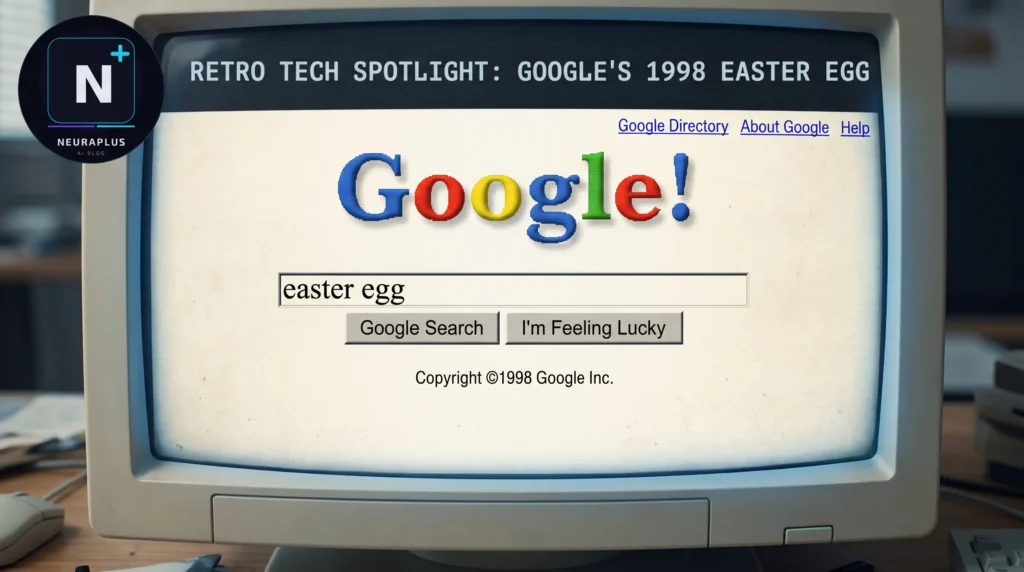
Long before autocomplete, video results, and AI summaries took over the search bar, Google in 1998 looked almost nothing like the platform people use now. Back then, a search page carried just one logo, a handful of links, and plain blue text. Even so, that basic design carried the same core idea that still drives Google today: give people the most relevant answer, as fast as possible.
What makes this story interesting is that you don’t have to imagine that old design anymore. A single search phrase brings the entire 1998 layout right back to your screen. So, before diving into how this trick works, it helps to understand why Google built it, what it actually shows, and how far search technology has traveled since those early days.
What Google in 1998 Actually Looked Like?
The old Google interface removed virtually everything that contemporary users need in a homepage. It featured no advertisements, no pictures, no customized recommendations, and a search box on a plain white space. Consequently, all the designs were directed to a single objective: assisting the user in getting quick answers.
Key elements of the 1998 layout
- Classic logo featuring an exclamation mark, styled as “Google!”
- Plain HTML formatting with minimal graphics
- Simple navigation links instead of dropdown menus
- A visible copyright line reading “1998 Google Inc.”
Since internet speeds were slow at the time, light pages did not take long to load and were compatible in most browsers. As a result, simplicity was not a style; it was a pragmatic need.
How to Trigger the Google in 1998 Search Feature
Bringing this retro layout back to life takes only a few seconds, and no technical setup is required. It can be accessed by anyone just by a typical Google search, regardless of whether they are using a phone, tablet, or desktop browser.
It is only necessary to open Google and enter ” Google in 1998 ” into the search bar. This immediately changes to the older and less graphic results page. When you are done with the search, any new search immediately takes you back to the modern interface; therefore, nothing is permanently altered on your device.
Why Google Built This Retro Feature?
This Easter egg was not a mere twinkle in the eye. It was published in September of 2013 by Google, the 15th anniversary of the corporation. Annually since the domain was initially available in September of 1997, the anniversary coincided with a nostalgic look back at the point of genesis.
Believing it was an interesting coincidence, Google had also released an interactive doodle that particular month in commemoration of the milestone. But the 1998 search trick remained subtler, as it only showed up when one searched with the exact phrase. That subtlety turned it into something users had to discover and share, rather than a feature pushed directly onto the homepage.
The Origins Behind Google’s Search Technology
Google began as a research project at Stanford university much before it became a household name. Two graduate students (Larry Page and Sergey Brin) desired to create a smarter system to measure the web pages that really count.
Their algorithm was to be called PageRank, which ranked pages by the number of other trustworthy sites that linked to them. Since this method offered significantly superior performance to those of the current search engines, the word of the project very soon circulated among the early internet users. Not long after, Google Inc. was formally incorporated in September 1998, turning a university experiment into an actual company.
Google in 1998 V/s Today’s Search Experience
Comparing the two versions side by side makes the shift in search technology much easier to understand. While the core function stays the same, nearly everything surrounding that function has changed dramatically.
| Aspect | Google in 1998 | Google Today |
| Homepage Design | Static, text-only layout | Dynamic and interactive |
| Search Results | Plain text links | Images, videos, news, AI summaries |
| Personalization | None available | Location-based and user-specific |
| Loading Speed Priority | Extremely high due to slow connections | Optimized but less restrictive |
Although the interface has been modified in an unimaginable way, one thing has remained the same, and that is: Google is still more concerned about relevance rather than decoration, however sophisticated the tools that hit the interface are.
Fan-Made Versions That Recreate the Full Experience
Since Google’s official Easter egg only updates the results page, several independent developers decided to build something more complete. These fan-created replications envelop the whole retro interface within an emulated Internet Explorer 4.0 browser frame.
Internet Explorer 4.0 was hugely popular in the years 1997 and 1998, and this was mainly due to the fact that it brought with it features such as Active Desktop and also support of Dynamic HTML, among others. With an imitation of this browser to the dot, these unofficial projects put back pixelated fonts and retro window appearance, making the whole experience that much more real than a plain results page alone.
Why This Retro Search Trick Still Matters?
Search engines rarely preserve their own history in a way people can actually interact with. Most companies rely on blog posts or anniversary videos instead, yet Google chose a more hands-on approach by keeping a working version of its past accessible.
This matters most for younger users who never experienced a search engine without images or instant answers. Since text alone can only explain so much, actually seeing the old design creates a much stronger sense of how far search technology has come. Meanwhile, users who remember typing queries into that plain layout often feel a strong wave of nostalgia when the page reloads.
Common Misunderstandings About This Feature
A few misconceptions come up repeatedly whenever this topic gets discussed, so clearing them up helps set realistic expectations before trying it out.
- The retro layout doesn’t change your permanent search settings in any way.
- Official and fan-made versions aren’t identical, since Google’s version only affects the results page.
- The 1998 design shown isn’t a perfect historical archive; it’s a stylized recreation built for nostalgia.
Because these details often get mixed up online, understanding them beforehand prevents unnecessary confusion.
A Simple Way to Understand the Shift in Design
Think about comparing an old flip phone to a modern smartphone. Both devices technically let you make a call, yet everything surrounding that basic function looks completely different today. In 1998, Google created that same contrast for search.
You still type a question and receive a list of answers, just as users did decades ago. Still, the depth, speed, and intelligence behind those answers have transformed almost entirely. That gap is exactly why this small feature continues to catch people’s attention, even years after its original release.
Final Thoughts
The reason why Google in 1998 works is the fact that it does not merely narrate to you how search engines used to appear; rather, it demonstrates it to you. A single search query can transport you back to a more modern, AI-supplied search result page and back to a simple, text-only design created by two students in a university laboratory.
That kind of contrast rarely survives this cleanly in tech history. Most early web products vanish entirely or only exist as scattered screenshots across forums. Instead of letting its own history become extinct, Google preferred to preserve a living relic of its own past, one that could be accessed by anyone willing to type a couple of words in a search. Take it once, and you will surely know the reason why this minor feature has been lasting more than 10 years.
FAQs
Is Google in 1998 an official Google feature?
Yes, Google built and released this Easter egg itself.
How do I open the Google in 1998 page?
Type “Google in 1998” into the search bar and press Enter.
Does this feature work on mobile phones?
Yes, it works smoothly on both mobile and desktop browsers.
Will this retro trick change my search settings permanently?
No, the layout reverts automatically after your next search.
Why does the old logo include an exclamation mark?
Early branding trends from the late 1990s influenced that design choice.
Who created the original ranking system behind Google?
Larry Page and Sergey Brin developed it while studying at Stanford.
When was Google officially incorporated as a company?
Google Inc. was incorporated in September 1998.
Are fan-made 1998 recreations the same as Google’s version?
No, fan versions add extra browser styling that Google’s original doesn’t include.
Does the 1998 version show images or videos?
No, the layout only displays plain text and simple links.
Is this feature still working in recent years?
Yes, it continues to function exactly as intended.
Read More: OXZEP7 Software: Is It Real? Truth Behind the Viral Tech Term and Fake Tutorials