
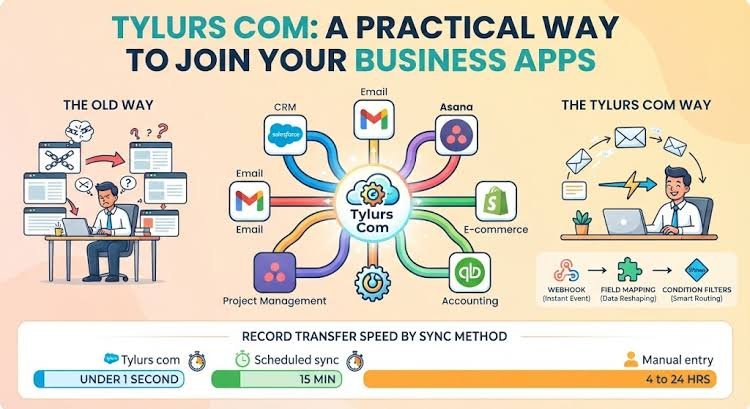
Tylurs com is a no-code integration platform that connects your business apps and lets them share data automatically. Instead of manually copying information between tools, Tylurs. com uses webhooks, field mapping, and rule-based logic to move records the instant something changes. This guide breaks down exactly how it works, how to set it up, and why more teams are switching to it in 2026.
If you run a business with more than a handful of software tools, you already know the pain. One app holds your customer data. Another handles invoices. A third manages support tickets. None of them talk to each other unless someone forces the connection. Tylurs exists to close that gap without writing a single line of backend code.
What Is Tylurs Com?
Tylurs com is a middleware layer that sits between your existing software and keeps everything synced. It does not replace your CRM, your accounting tool, or your project management app. Instead, it links them together so data flows automatically whenever an event happens.
Think of it as a translator and a messenger rolled into one. When a customer signs up in one app, tylurs notices instantly and pushes that record wherever it needs to go next. No manual entry. No delays. No mismatched spreadsheets.
This matters more than ever in 2026, since most companies now run five or more disconnected SaaS tools at once.
Why Disconnected Business Apps Slow Your Team Down
Every time an employee switches between apps, focus drops. Researchers at Harvard Business Review found that constant app-switching drains mental energy and increases mistakes. That fatigue adds up fast across a full workday.
A team juggling five to seven unlinked tools can lose close to 20% of its weekly output. That is nearly one full workday every week, wasted on repetitive copy-paste tasks instead of actual work.
Here is where the damage typically shows up:
- New customers wait longer during onboarding because records sit in the wrong system
- Inventory counts stop matching across sales and warehouse tools
- Sales leads sit unread in an inbox nobody checks regularly
- Support tickets get duplicated across two different platforms
Tylurs removes this friction. Once a workflow is live, a single update in one app automatically triggers every related action across your other tools.
Still, real automation needs more than a basic connection between two apps. A dependable workflow also needs condition logic, data reshaping, and smart handling of API rate limits. Teams that skip this step often run into common integration roadblocks within the first few weeks.
The Three Core Components Behind Every Tylurs Com Workflow
Every automated sequence built on tylurs relies on three working parts. Understanding these makes the rest of the setup process much easier.
| Component | Function |
| Webhooks | Send data the moment an event happens, so nothing waits on a scheduled check |
| Field Mapping | Reformats data mid-transfer, such as converting JSON into XML, so both apps can read it correctly |
| Condition Filters | Applies if/then logic to route each record down the correct path |
Here is how a single workflow typically runs from start to finish:
- An event fires inside the source app
- The payload lands inside tylurs com
- Condition filters check the data against your rules
- Records that pass get reshaped through field mapping
- Clean records push through to the target app
- Records that fail get logged, and the workflow pauses for review
This same webhook-driven approach also powers modern event-triggered tools that launch jobs the second a condition is met, rather than running on a fixed timer.
How Fast Is Tylurs Com Compared To Manual Entry?
Speed is one of the biggest reasons teams switch. Manual data entry simply cannot compete with automated, event-triggered syncing.
| Sync Method | Average Speed |
| Manual batch entry | 4 to 24 hours |
| Scheduled two-app sync | Every 15 minutes |
| Tylurs com setup | Under 1 second |
Speed is only half the story, though. Manual entry also carries a high error rate because people get tired and slip up. Basic point-to-point syncing tends to break the moment a connected API updates its structure. Tylurs, on the other hand, catches failed calls automatically, retries them, and scales up resources whenever traffic spikes.
How Tylurs Com Cleans And Reshapes Data In Transit
Fields rarely match perfectly between two different apps. An older database might store a single combined name field, while a newer CRM expects separate first name and surname boxes. Fixing that mismatch requires an engine capable of splitting, reading, and reformatting text while the record is still moving.
During a rebuild for a media company, thousands of files arrived every hour with messy metadata labels. A custom filter inside tylurs stripped extra spaces, split each string at its divider, and converted every timestamp into a single timezone before the data ever reached the main servers.
For example, a messy input like:
” rossi, marco | 2026-06-14T00:45:31Z “
became a clean, structured record:
- First name: Marco
- Surname: Rossi
- Timestamp: 2026-06-14 00:45:31
Clean data does more than improve accuracy scores. It also prevents sync loops from breaking and lowers storage costs. According to MIT research on data architecture, well-structured pipelines can cut long-term maintenance costs by up to 35%.
Building A Tylurs Com Workflow Step By Step
Setting up your first workflow is more straightforward than most people expect. Follow these four stages in order.
Groundwork: Secure Your Sign-In
Before anything else, exchange OAuth tokens or coded API keys between your source and target apps. Always grant the smallest set of read and write permissions that still gets the job done. This limits your exposure if credentials are ever compromised.
Before this stage begins, it also helps to lock down the servers on both ends. A quick server security audit covering SSH access, user permissions, and activity logs catches weak points before any credentials change hands.
Phase 1: Add The Listener
Create a URL endpoint inside tylurs that catches inbound JSON payloads. Send a test payload right away and check the header response to confirm the connection works correctly.
Phase 2: Match The Fields
Pair every incoming value with the correct target field. Add small formulas to clean up text, fix inconsistent date formats, and set fallback values for anything left blank.
Phase 3: Plan For Failures
Build a branch that handles refused calls and timeouts gracefully. Set retries with exponential backoff so external servers never get overwhelmed with repeated requests.
| Stage | Task | Action |
| Groundwork | Secure sign-in | Exchange OAuth tokens or API keys with minimal permissions |
| Phase 1 | Add the listener | Create an endpoint and test with a sample payload |
| Phase 2 | Match the fields | Align values, fix formats, set fallbacks |
| Phase 3 | Plan for failures | Add retry logic with exponential backoff |
Once your workflow goes live, keep monitoring it. Execution logs reveal which API responses are slow, and a lagging response almost always points to a bottleneck somewhere upstream.
How Tylurs Com Protects Your Data
Security matters just as much as speed. Tylurs com encrypts traffic using TLS 1.3 while data moves between apps, and stores anything at rest with AES-256 encryption. Sensitive records also get wiped from interim run logs once a workflow finishes, following the same practices used to secure Linux-based platforms.
This layered approach means your business apps stay connected without exposing customer data along the way.
Where Tylurs Com Fits As Your Tech Stack Grows
Business software keeps shifting toward setups where machine learning tools work alongside standard integrations. Keeping your operating rules centralized inside tylurs com means new AI analysis tools and databases can slot in easily, without disrupting your existing technical core.
This mirrors the exact problem that application migration and modernization firms solve at a much larger, enterprise scale.
Teams that eventually outgrow no-code workflows still have options. In-house developers, or enterprise software teams working in Linux environments, can extend the same workflows with custom code blocks instead of rebuilding everything from scratch.
Key Benefits Of Using Tylurs Com
To summarize the advantages covered so far, here is what teams gain once they adopt tylurs:
- Instant data transfer through event-triggered webhooks
- Automatic error handling with built-in retry logic
- Clean, reshaped data that reduces long-term storage costs
- Flexible scaling during high traffic periods
- Strong encryption for data both in transit and at rest
- Room to add custom code blocks as needs grow
Conclusion
Disconnected business apps quietly drain time, accuracy, and revenue from every team that relies on them. Tylurs com solves this by linking your tools together through fast, reliable, no-code automation. From webhooks that fire in under a second to field mapping that cleans messy records on the fly, tylurs com gives businesses a practical way to stop the manual busywork and start scaling with confidence. Whether you are connecting two simple apps or building a complex multi-step workflow, tylurs adapts as your stack grows in 2026 and beyond.
Frequently Asked Questions
What is tylurs com used for?
Tylurs com links business apps together through a no-code integration layer. It moves data using webhooks, reshapes fields during transfer, and applies if/then logic, all without requiring custom backend code.
Is tylurs com faster than scheduled app syncing?
Yes, Scheduled syncs typically check for updates every 15 minutes, while tylurs com pushes data through webhooks in under one second since real events trigger the transfer instantly.
What happens when API traffic spikes on tylurs?
The platform automatically spreads workloads across additional resources as volume increases. If an external service hits a rate limit, waiting payloads queue up and process once the API accepts requests again.
Can I add custom scripts to tylurs com workflows?
Yes, You can drop JavaScript or Python blocks directly into a visual workflow, combining no-code speed with custom logic for edge cases the standard modules cannot handle.
How does tylurs keep data secure?
Traffic is encrypted with TLS 1.3 while moving and AES-256 at rest. Sensitive records are also cleared from temporary run logs after each workflow completes.
Does tylurs com work for small teams or only large companies?
Both. Small teams benefit from removing manual entry early, while larger companies use tylurs to manage complex, multi-app workflows at scale.
Read More: OpenJDK 8 Download: Install Guide for All Platforms