
Most people use Google Search every single day without ever noticing its playful side. Hiding in the search engine back door is a tool feature known as Google Askew, and it does something entirely surprising when you search it. Rather than present you with a boring results page, Google also tilts the whole display to the right as though someone was tapping you on the shoulder. It is minor, but when you first lay your eyes on it, it really makes you freeze.
The trick has been in operation since 2010 and is still valid today. Not only is it an enjoyable surprise, but it also imparts to you something genuinely about the askew meaning, since the very page is an illustration of the word, going crooked. And thus, whether you have been here by accident or you are here to find out all that is of interest to know about the Google Askew Easter egg, how it functions, why Google created it and what more you can find lurking in Search, all of this is explained here.
What Is Google Askew?
Google Askew is a hidden Easter egg built directly into Google Search. When an individual enters the word askew or tilt in the search box and presses the enter button, the whole results page will turn a bit on the right-hand side. The search results, as such, remain entirely standard, but the point of view of the page changes enough, which makes you take a second look.
This feature was an invention by Google engineers as a vocabulary trick. Askew literally translates to crooked or out of orientation; therefore, rather than presenting a typical definition in a dictionary, Google brings its interface to illustrate the meaning. That expressing not telling, renders this Easter egg more ingenious than the majority. It connects the word directly to a visual experience, which makes the definition stick in your memory far better than reading plain text ever would.
Askew Meaning Explained
The perception of the askew meaning will make you get why Google chose this particular word to make a visual impact. Askew is a Middle English word which is used to refer to something that is not in a straight position or is tilted at an uneven angle. Commonly used in daily life, it is used to characterise physical objects that are visually off-balance or tilted.
Everyday Examples of Askew in Real Life
You come across this term in real-life situations more than you notice. The following are some typical real-life applications:
- A picture frame on a wall that hangs at a slight angle
- A hat tilted sideways on someone’s head
- A street sign that leans to one side after a storm
- Rows of chairs in a room that are not perfectly aligned
- A shelf that was installed slightly crooked
All these scenarios are telling how something is not wrong, broken, just not straight. And the essence of the askew meaning is that, and that is what your Google search page appears as when opened in the Easter egg.
How to Try Google Askew Right Now?
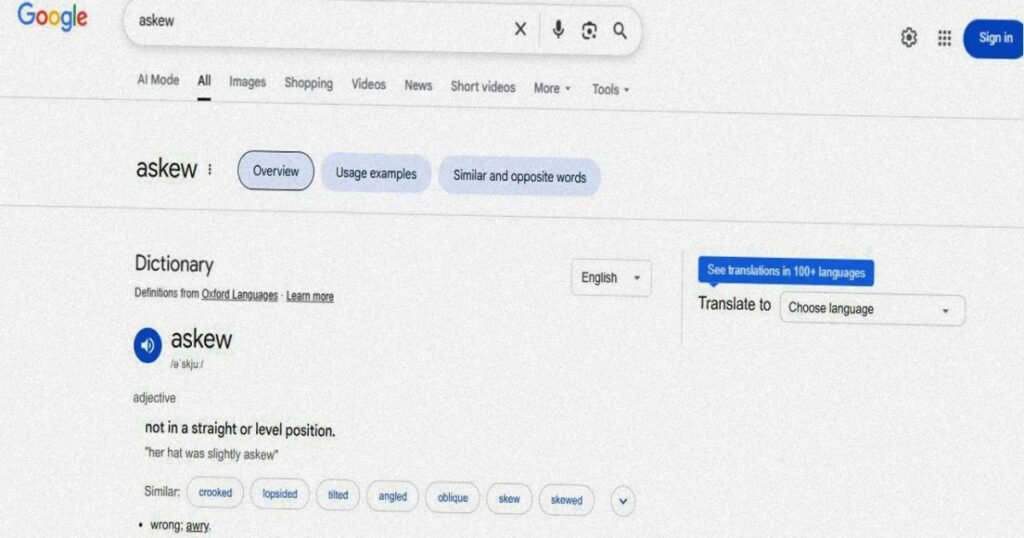
Trying this takes about five seconds. No browser extension is needed, no account is needed and no special setup of any kind. It is as simple as the steps below and watch it come to life.
| Step | Action |
| 1 | Open Google.com in any browser |
| 2 | Type askew or tilt in the search bar |
| 3 | Press Enter or tap Search |
| 4 | Watch the entire results page tilt to the right |
| 5 | Refresh the page to return to normal |
The tilt is subtle and thus, one must compute the entire page structure as opposed to the emphasis on one text line. It can be easily understood when your eye arrives at the angle. This is compatible with desktop browsers, laptops, tablets and cell phones regularly.
What Happens When You Refresh
Whenever you refresh the page or do any other search, the tilt goes away entirely. Its impact is temporary, does not affect any browser settings, and does not impact the functioning of Google in any other manner. It is merely visual, as well as completely provisional.
The Technical Side of How Google Askew Works
The Google Askew effect is powered by a straightforward yet graceful web technology code known as CSS. CSS is known as Cascading Style Sheets and it determines the appearance of the web pages within a browser. CSS will enable developers to spin any element in a page at a given angle through one CSS property.
A rotation transformation is also done on the visual layer of the results page when Google notices the following words in a search query: askew or tilt. Underneath, the real-world search information such as your results, links and rankings, loads fully normally as any other web page would do. It is only the display layer that is rotated. It is why the trick is clean and harmless; it is incapable of being otherwise. There is nothing altered in your search query or data or your browser. The page simply appears tipped as long as one remains on it.
Askew Left: What People Search for and What Google Actually Does?
After using the usual trick, many are left wondering whether the page can be tilted leftward, asking Google the question askew left. Here, then, is the simple answer. The inbuilt Easter egg in Google merely nudges the page to the right. No askew left version is available as an official part of the real Google search.
It is understandable why they were curious. As soon as one has watched a page tilt one way, the only next thing that one would think is the possibility whether it tilts the other way as well. Certain third-party sites and browser extensions have made duplicate versions in which the page is tilted to the left, which are completely out of Google infrastructure themselves. Should you wish a form of official Easter egg that is tilted to the left in Google search, it is not an inherent feature at this time.
Google Askew vs Other Famous Google Easter Eggs
Over the years Google has developed dozens of under the hood features in its products. The following askew trick is a certain type of vocabulary Easter egg, in which the effect provides a visual illustration of the meaning of the word you sought. That places it in a special category along with only a few others.
| Easter Egg | Search Term | Effect | Category |
| Google Askew | “askew” or “tilt” | Page tilts right | Vocabulary / Visual |
| Kerning | “kerning” | Letters space out visually | Vocabulary / Visual |
| Do a Barrel Roll | “do a barrel roll” | Page spins 360 degrees | Visual |
| Recursion | “recursion” | Google suggests “recursion” again | Text / Humor |
| Pac-Man | “pac-man” | Playable arcade game loads | Interactive Game |
| Zerg Rush | “zerg rush” | O’s attack the results | Interactive Game |
| Google in 1998 | “google in 1998” | Page reverts to 1998 design | Nostalgia / Visual |
| Google Gravity | “google gravity” | Page elements fall down | Physics / Visual |
Why the Vocabulary Easter Eggs Stand Out?
Among all the Easter eggs Google has ever built, the ones related to vocabulary such as askew and kerning, have the most educational value behind them. They are not simply amusing. The experience also gives you a lesson in the English language. It is that duality of point that further makes them more memorable and worth sharing than a mere animation or spinning effect.
Why Google Builds Easter Eggs?
Google engineers have the tendency to create Easter eggs as part of a company policy known as 20% time. The policy allocates some hours to employees so that they can use the time on personal projects and experiments they would have otherwise avoided doing due to their key duties. A lot of the most popular features of Google were a result of this sort of experimentary time.
To look at it, product design-wise, the Easter eggs, such as Google Askew, have a legitimate, non-entertaining intent. They are so-called delight moments by designers, tiny surprises, that make a product more human and enjoyable to work with. When one finds the askew trick, he/she nearly never fails to share it with another person around. That word of mouth generates brand affinity with no advertising money outlay whatsoever. The smallest of CSS rotations does the marketing campaign in silence.
A Real Scenario: How Someone Discovers Google Askew
Picture a high school student working on a vocabulary assignment late at night. She needs to use the word “askew” in a sentence but wants to double-check the definition first. She types it into Google, and the page tilts. Then she stares at her screen, blinks, and then tilts her head to match the angle. She refreshes and tries again. The page tilts again. She immediately texts her friend to try it.
The following morning, that student recalls only too clearly the oblique meaning, not because she read a meaning, but because her computer screen played it to her. It is the true worth of this Easter egg. It transforms one of the unmemorable vocabulary searches into an experience to remember and forward.
Other Google Easter Eggs to Try After Askew
After using Google Askew, you just wonder what other things Google has created for Search. Some are really worth trying and each has its own personality.
Top Google Easter Eggs Still Active in 2026
- Do a Barrel Roll: The page spins a full 360 degrees. It is dramatic and gets a big reaction from anyone watching.
- Pac-Man: A fully playable version of the 1980 arcade classic loads right in your browser with arrow key controls.
- Conway’s Game of Life: A cellular automaton simulation runs in the corner of your results page, based on mathematician John Conway’s 1970 model.
- Kerning: Every instance of the word “kerning” on the page spaces its letters out to visually demonstrate the typography term.
- Recursion: Google cheekily suggests “Did you mean: recursion?” when you search recursion, creating an infinite loop joke.
- Zerg Rush: Small letter O’s fall from the top of the page and destroy your search results one by one.
- Google in 1998: The entire search interface transforms back to what Google looked like when Larry Page and Sergey Brin first launched it.
These are all in other categories. There are the playful ones, the nostalgic ones, and some, as Google Askew, are both amusing at the same time, and truly educational.
Final Thoughts on the Google Askew Easter Egg
The Google Askew trick has stayed active for over fifteen years, and that staying power reflects something genuine about its design. It is not noisy and complex. It is a single action of throwing the page to align in the askew sense and vanishes once you pass on. Having nothing complicated about it.
Google might have presented a spinning image or a pop-up or flashy effect. Rather, it decided to go the most literal of replies: enter a word that signifies tilted and your page tilts. This silent, self-aware relationship between words and experience is what renders this Easter egg, the sort of thing worth knowing about, and sharing the next time someone at a McCarthyism dinner has never seen it.
Also Read About: Error RCSDASSK: Complete Fix Guide for Windows, Linux and macOS